
Belgrave Consultancy/ERP implementation guide

ERP implementation guide

You need a better system. You also need the business to keep running.

When teams depend on separate spreadsheets and disagree about the numbers, a new ERP can feel overdue. But choosing the software is only one part of the work. The Software Is Not the Problem helps you prepare the business, agree what the system needs to do and plan the implementation with your team.

€99 including VAT · PDF · Instant download

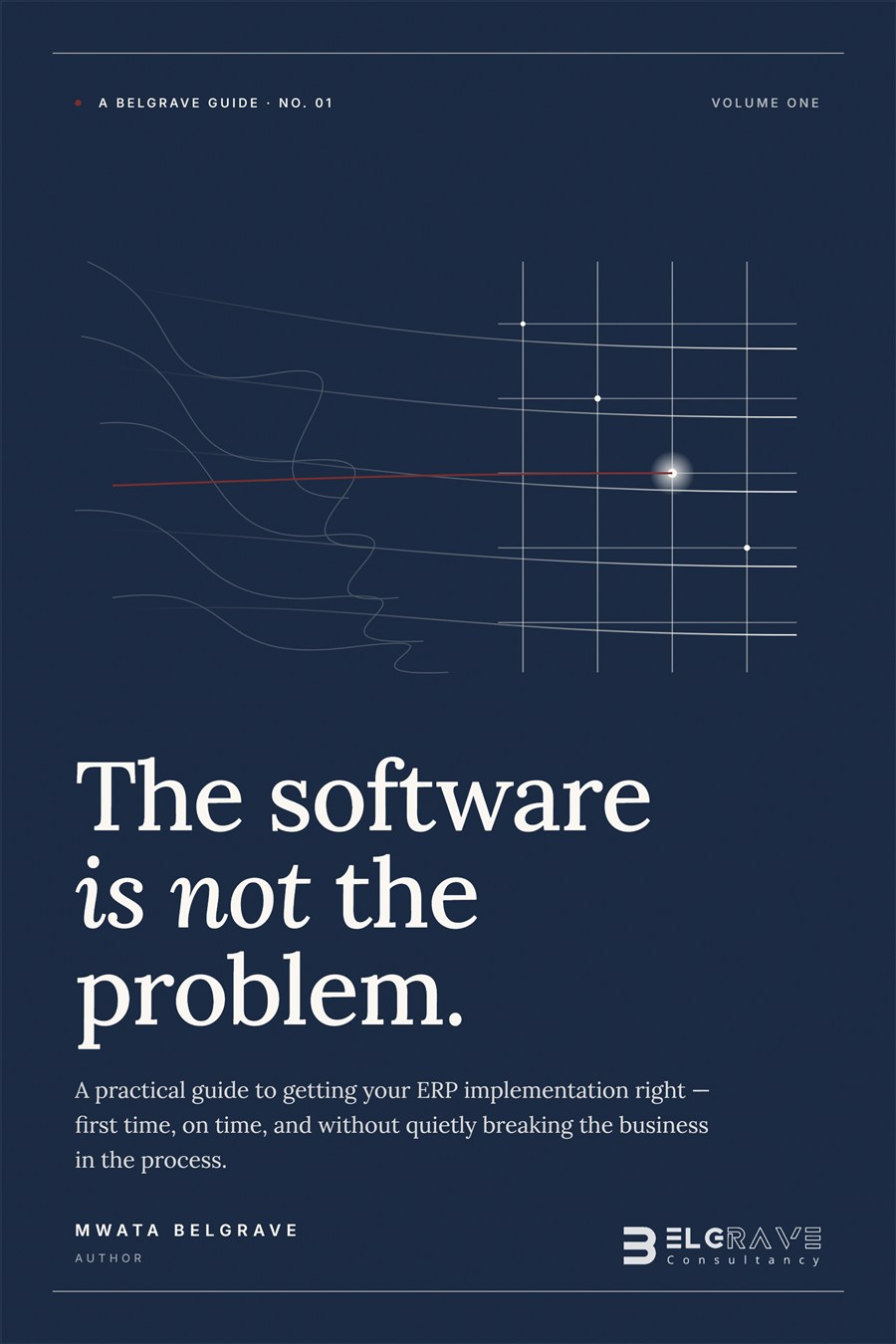
Cover of The Software Is Not the Problem, a Belgrave guide to ERP implementation
  • ForManaging directors, operations directors and project leads in businesses of roughly 30 to 250 people
  • ContentsThree parts, 13 chapters and 8 appendix tools
  • FormatPDF, about 95 pages. The tools are printed in the PDF; separate editable templates are not included.
  • AuthorMwata Belgrave, who led three ERP implementations on the business side

Vendor-neutral. Not a software comparison or a configuration manual. Already in the middle of a difficult implementation? Talk to me about your situation.

Does this sound familiar?

Before you commit, get clear on the work ahead.

The situationWhat the guide helps you work through
"Finance, operations and projects are working with different figures."Define what needs to improve and agree what success should look like.Chapters 1 and 4
"Everyone wants a new system, but each department has a different list of requirements."Map the work and turn it into requirements the business can agree on.Chapters 2, 3 and 8, Appendices A and B
"The demonstration looks convincing, but we are unsure what the full commitment involves."Compare vendors against clear criteria and examine the total cost over five years.Chapter 5, Appendix C
"The people needed for implementation already have full-time jobs."Plan responsibilities, internal capacity, testing and preparation alongside everyday operations.Chapters 6, 7 and 11, Appendices D to F

Selecting the software is one part of the work. Preparing the business is the other, and the guide gives you a structured way to do it, along with the implementation decisions that follow.

A quick way to check readiness

Free ERP resources

A scorecard and a costing checklist, by email.

Get the free resources
A structured reference for your team

The guide, €99

The full PDF with eight tools.

Buy the guide
Help with your own decisions

A consultancy conversation

Your requirements, readiness or implementation.

Discuss your ERP situation

Preview

Read a sample before you buy.

A leadership summary, a process diagram and part of the readiness scorecard show how the guide explains the work and helps you discuss it with your team. Each extract opens larger.

The three extracts below are set for the screen. The first pages open as they appear in the PDF.

Read the first pages of the guide

Chapter 1 · Leadership summary

What leadership needs to know

The decision to implement an ERP is rarely the hard part. Preparing the organisation for what comes next is.

Most implementations run into difficulty because of insufficient preparation, not because of the software.

Before any vendor conversation begins, your business needs to answer five fundamental questions honestly.

The cost of a poorly prepared implementation is measured in months and budget overruns, not minor inconveniences.

Leadership commitment starts now, not at contract signing.

Every chapter opens with a box like this. For a quick overview, start with the leadership summaries.

One of 15+ diagrams · Process clarity

How we think it runs, and how it actually runs Two rows of five process steps. The top row is a clean line. The bottom row has workarounds drawn as dashed loops, including one red exception route. ABOVE THE SURFACE: HOW WE THINK IT RUNS Order inApproveAllocatePick & packDispatch BENEATH THE SURFACE: HOW IT ACTUALLY RUNS Order inApproveAllocatePick & packDispatch phone ordersvia a spreadsheet EXCEPTION: LARGE ITEMS

In words: on paper an order moves cleanly from order in to dispatch. In practice it passes through phone orders, a spreadsheet and an exception route for large items. The wider the gap between the two, the harder the landing at go-live.

Friction at go-live is the distance between the two.

Appendix A · Readiness scorecard

Dimension 1, process clarity: can your business describe how it operates, step by step, in a way that an informed outsider could understand?

  1. 1No process documentation exists. Processes live in people's heads.
  2. 2Some informal notes exist, but are incomplete and inconsistent.
  3. 3Key processes are partially documented. Core flows exist but lack detail, RASCI or agreed boundaries.
  4. 4Most core processes are documented. Minor gaps or outdated sections remain.
  5. 5All core processes documented to procedure level (scope, flowchart, narrative, RASCI, related documents) and reviewed within the last 12 months.
One of seven dimensions. Scored out of 35 in total.

What's included

Three parts, thirteen chapters and eight appendix tools.

  1. Prepare the business: processes, objectives, the case for change and vendor selection.
  2. Run the implementation: responsibilities, requirements, data, training, testing and go-live.
  3. Make the system work over time: the first months after launch and ongoing review.

The PDF is about 95 pages and includes leadership summaries, eight appendix tools and a list of sources. The tools are printed in the PDF; separate editable templates are not included.

View the full contents

Part one: Get your house in order first
  1. So you've decided to implement an ERP. Now what?
  2. Your processes are the blueprint: without them, you're building blind
  3. How to actually map your processes (without losing your mind)
  4. Making the case: getting the organisation behind the decision
  5. Choosing the right system: how not to get dazzled by the demo
Part two: Run the project without running your business into the ground
  1. Setting up for success: governance, team, and getting the scope to stay still
  2. Project initiation and discovery: knowing what you're building before you build it
  3. The requirements phase: defining what the system must do
  4. Data migration: the project within the project
  5. Change management: because your people actually have to use this thing
  6. Testing and go-live: the final push
Part three: Protect and grow your investment
  1. The first 90 days: staying calm when it gets messy
  2. Living with your ERP: the starting line, not the finish line
The toolkit: eight appendices
  • A. Implementation readiness scorecard
  • B. Procedure template
  • C. Vendor evaluation framework
  • D. Implementation team roles and responsibilities
  • E. Data migration checklist
  • F. Go/no-go checklist and test script template
  • G. ROI measurement framework
  • H. Annual ERP health check

A practical reference for you and your project team

The Software Is Not the Problem

€99including VAT

  • The full PDF: all thirteen chapters and eight appendix tools
  • Licensed for use within your organisation
  • Payment and delivery are handled by Lemon Squeezy, the seller of record

Need help with your own implementation?

The guide gives you a structure to work with. If you need support with your company's requirements, readiness or implementation decisions, we can discuss a separate consultancy assignment, or a review of your readiness scorecard.

Free ERP resources

Start by understanding where you stand.

Use the readiness scorecard to compare how your leadership team sees the preparation ahead. The project costing checklist helps engineering and project-based businesses examine what they need to understand before ERP workshops begin.

A three-question ERP preparation check

A quick indication only, not the full scorecard. Score each statement from 1 (not in place) to 5 (fully in place). Nothing is stored.

Could you describe your core processes, step by step, to someone who has never worked in your business?
Does your leadership team give one clear, shared answer to "why are we implementing an ERP?"
Is there a named person whose active commitment, not just approval, is tied to the ERP project's success?
1 · Not in place5 · Fully in place

Free PDF

ERP Implementation Readiness Scorecard

Review seven areas of preparation, including process clarity, leadership commitment, internal capacity and data quality. Complete it individually, then compare the team's answers. This is the guide's readiness scorecard (Appendix A), available separately as a free PDF.

The download link appears as soon as you submit. Your email is used only for that and, if you tick the box, for follow-up emails. Privacy

Free PDF

Project Costing Discovery Checklist

Examine how you track costs, changes and the work still to complete. Use it to identify questions that finance and project managers need to settle together before ERP workshops begin. Seven areas, scored out of 35.

The download link appears as soon as you submit. Your email is used only for that and, if you tick the box, for follow-up emails. Privacy

About the author

Mwata Belgrave

I was Director of Operations at an offshore energy engineering company and led three ERP implementations on the business side. I now advise management teams independently.

About me   My consultancy

Is this guide about a specific ERP system?

No. It is vendor-neutral and applies to any ERP. Its principles may also help with other systems that cross several departments.

My business is smaller than 30 people, or larger than 250. Is it still useful?

The principles apply at any size. The examples and team structures are written for businesses of roughly 30 to 250 people.

We are already mid-implementation. Is it too late?

No, the principles apply at every stage. But if you need help with a live project now, a conversation with me may be more useful than the guide alone.

How long does it take to read?

The leadership boxes take under an hour. The full guide is designed to be read once and then used as a reference throughout the project.

What format is it, and when do I get it?

A PDF of about 95 pages, delivered by email straight after purchase. Eight tools are printed in it as appendices.

Can I share it with my project team?

Yes, within your own organisation and for your own project. You may print it and use the tools. Please do not copy, resell or publish it, and do not pass it to other companies. A consultant who wants to use it with clients needs a separate licence: ask me.

Do you offer a refund?

If you are an EU consumer you have 14 days to cancel after purchase. Beyond that, if the guide is not what you expected, email me within 30 days with your order number and the reason, and I will look at it fairly.

Give your team a clearer starting point.

Work through the preparation and decisions before they become urgent.